Tuesday, May 7, 2013
First crack at Kaqchikel
Most students who study Spanish here in Guate average four hours a day of one-on-one instruction. Kaqchikel lessons, though, max out at two-hour increments. Yesterday, I discovered why.
Kaqchikel is one of some 22 or 23 distinct Mayan languages spoken by indigenous people here in Guatemala. It sounds like some combination of Spanish, Hebrew, French, popping, clicking, swallowing, clearing your throat and speaking with a candy in your mouth. (To clarify, this is indeed a pleasant sound). It's common to the areas in which we are travelling, and I thought it would be nice to know some basic greetings when visiting Friendship Bridge clients or chatting with the people around me. Many people in the cities speak Spanish plus an indigenous language.
I love learning new languages (or "collecting" them, as a friend once said) and usually pick things up pretty quick. I thought that I had a pretty good ear for subtleties in languages, perhaps even a head start thanks to my many Jewish friends who have taught me to "hhhuch" -- until yesterday, when I spent about 10 minutes trying to correctly pronounce "good afternoon."
I just couldn’t get it out and couldn't hear what I was doing wrong. We went back and forth:
Gregorio: Good afternoon
Cara: Good afternoon.
Gregorio: No. Good afternooooon.
Cara: Good afternoooooon.
Gregorio: Good. Af-ter-noooooon.
Cara: Good. Af-ter-nooooon.
Gregorio: No.
Cara: Good afternoon.
Gregorio: Si!
Cara: Good afternoon.
Gregorio: No...
In my defense, though, I wasn't just talking jibberish: with the slight adjustments I was apparently making, my teacher Gregorio told me my pronunciation of, "I'm going to hit the table" was perfect.
He also got a big kick out of my attempt at "good morning," or as I like to say, "You have big horns."
After the first hour, we had to take a break. We both needed a glass of water for our sore throats. I did have some success, however, and it is fun to practice. People are really tickled when you try to speak Kaqchikel (probably because I am talking all kinds of nonsense).
My new nickname is "Palaj" which means "face" (just like "cara" does in Spanish).
Here's a video I found on the world wide web for you to hear how it's really done.
I will keep you all posted on my progress.

Sunday, May 5, 2013
Update from Panajachel
 |
| Johnny in front of our apartment in Pana |
It's been awhile since I last wrote -- a surprise to us both. I was expecting to spend long mornings blogging away, but the truth is I'm suffering technology frustrations. I brought an iPad and keyboard, which as it turns out is not the same as working on a laptop, especially for loading pictures, formatting blog posts, etc. I also decided to load all our pictures onto Google+ thinking that would make it easier to insert them into blog posts, but that turned out to not be the case. Ugh.
When you have some time to peruse photos, hop on to Google+ and you can see all the pics! (If you can't see them, let me know and I will add you to my circle of friends. Still figuring out Google+...).
I would love to answer your questions and hear from you!
We've set up camp here Panajachel, a town on Lake Atitlan. This is where one of the Friendship Bridge/Puente de Amistad offices is located. I am working part-time with Friendship Bridge to collect follow-up stories on clients who have received micro credit loans through their partnership with Kiva.
So far I've met three clients, including one Trust Bank group. Meeting these women is the part that I like best about being here. I visit places I would otherwise not go -- the high hills of Quetzaltenango, the outskirts of Patzun and Patzicia. I am invited into homes, smiled at by cute kiddos and gifted homegrown apricots that later give me tremendous diarrhea.
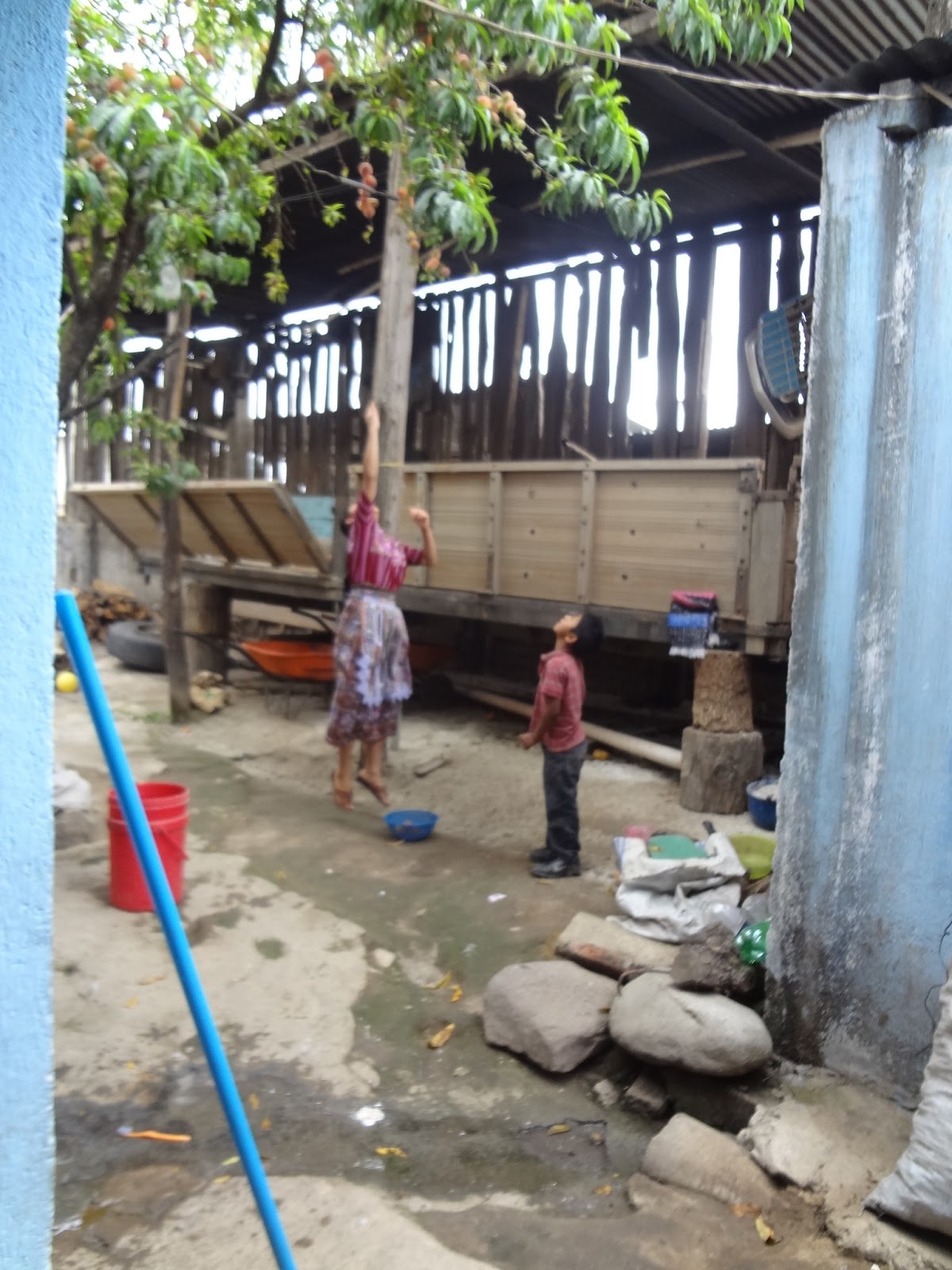 | |
| Kind people at a house I visited for an interview gave us fresh peaches from their tree. It was such a lovely gesture that some part of me thought, certainly such a nice peach, given of a kind heart, couldn't make me sick? Unfortunately it was freshly washed. Still can't handle the water. |
During our first couple weeks, I missed Antigua a bit, as life there was pretty cush. We lived in a beautifully designed, eco-conscious shared house owned by a Japanese couple our age. There were beautiful ruins and cathedrals everywhere you turned, organic restaurants, gourmet food shops, little haunts to enjoy freshly juiced licuados, cafes around flower-filled gardens, peaceful parks to sit by the fountain and even yoga class at the fancy hotel around the corner from my house. I spent a lot of time wandering, reading and unwinding my brain. Oh yes, and weaving. That was my favorite part.
 Panajachel -- or Pana, as it's known -- is touristy but in a different way. The main drag is lined with stalls selling bags, t-shirts, jewelry and pants. Some vendors are more aggressive, walking into restaurants and plopping their goods half-way onto your plate: hand-woven table runners, table cloths, bracelets and quetzal key chains. A couple days ago a lady actually wrapped my head in a head scarf while I
was mid-conversation. There are many small stores that seem to
all sell the same snacks and gross drinks... not as many unique,
adorable little haunts as Antigua. But some.
Panajachel -- or Pana, as it's known -- is touristy but in a different way. The main drag is lined with stalls selling bags, t-shirts, jewelry and pants. Some vendors are more aggressive, walking into restaurants and plopping their goods half-way onto your plate: hand-woven table runners, table cloths, bracelets and quetzal key chains. A couple days ago a lady actually wrapped my head in a head scarf while I
was mid-conversation. There are many small stores that seem to
all sell the same snacks and gross drinks... not as many unique,
adorable little haunts as Antigua. But some.Now that we have settled in, I am feeling more comfortable and enjoying it more every day. It should not go without saying that Lake Atitlan is absolutely beautiful. It is a huge crater lake surrounded by three volcanoes, and there are all these lovely towns nestled into its shores which you can reach by boat-taxi.
Each town has its own character: one is known for its many coffee and weaving coorperatives; another is the hippie haunt where the gringos have set up pyramid retreats, aura cleansing and reiki massage; one is home to the infamous Maximon.
 |
| On the docks in Pana |
  |
| Our place in Pana. You wish you thought of that color scheme. |

Like many houses, our bungalow is made of concrete block. It's topped off with a metal roof that makes even the lightest of rainstorms a real party. It's on a quiet street just off Calle Santander, where a majority of the touristy restaurants, book shops, cafes and Sombrilandia (which sells fresh fruit popsicles) are located. We're just a leisurely stroll from the docks.
That is my Sunday update. Today is market day, so we're off to buy our tomatoes, zucchini, onions, carrots and bananas for the week.
Miss you and love you!
Cara and Johnny
Get on the bus, Gus
Public transportation, the "chicken buses" and micro-buses, still
present a mental hurdle for me. I fear that somewhere along the way, I
have gotten older and more worrisome, or maybe I am just cautious by
nature.
"Chicken buses" are old American school buses that come down to Guate for a second life. They get a fresh paint job with vivid colors, flames and multi-colored stripes, then are supped up with flashing lines, loud horns and luggage racks. Almost all of them have a name, as any bus should.
These are the buses that
take you anywhere you want to go. Each one has a driver and an ayudante whose
job it is to fill the bus. They lean out the stairwell door, calling
out where we are going, shuffling people on as fast as possible and hauling their loads onto the roof. They
hop on and off the bus, sometimes running alongside it to jump into the
open
door. Then, the ayudante has to squeeze
through the jammed aisle to collect money from each passenger. It is
ridiculous.
The part that I don't especially like is they pack
these things FULL. I'm talking three people to a seat, plus an impossible number of people
standing in the aisle. Many of the passengers have a baby strapped on
their back, are carrying huge loads, or are older people precariously wobbling around. The drivers barely wait long enough for you to get on before
they take off at full speed, honking their horns to attract other
passengers and taking corners so hard that even they have to hold on for
dear life.
On multiple occasions I have had day dreams about the bus tipping over on the highway, and exactly which items would fall on me (a few kids, some guy looking at dirty pictures on his cell phone, a bundle of flowers, several backpacks, a rack of dried mystery snacks, a heavy bundle of zucchini, carrots, papaya and mangoes...) before my head hits the ground.
The thing is, this is the way you get around. In spite of all their --- quirks -- the buses definitely get you where you want to go, and they are inexpensive (a 3-hour trip cost something like 50Q there and back, or just over $6). Even better, almost anywhere can be a pick-up point, and almost anywhere can be a stop. (Well, as long as you can make it to the front of the bus in time). There's no exact schedule to follow in order to catch one, and if you can't read or don't know how to get to where you're going, there are plenty of people around to help you. Or you can just listen to their calls, Guate Guate Guate! A Pana Pana Pana! Los Encuentrooooooos!
On days when I have field visits for Friendship Bridge/Kiva, I take these buses for hours. My first trip to Quetzaltenango was three hours and 7 buses ONE WAY. If it's that hard to get there, imagine how hard it is to get a loan! Sorry, just a little microcredit joke.
I am getting used to the buses, slowly but surely. Once I can take my mind off how fast we are going and the paranoia subsides, the bus rides offer beautiful views of the countryside, aldeas tucked into rows of farm land, animals grazing and just people going about their business.
Most of all, I am grateful to have the opportunity to meet the Friendship Bridge clients and peek into their reality. It can be a long trip to reach them, but it has been worth it every time.
"Chicken buses" are old American school buses that come down to Guate for a second life. They get a fresh paint job with vivid colors, flames and multi-colored stripes, then are supped up with flashing lines, loud horns and luggage racks. Almost all of them have a name, as any bus should.
 |
| Photos from guatemalanchickenbuses.com |
 |
| Photo from guatemalanchickenbuses.com |
On multiple occasions I have had day dreams about the bus tipping over on the highway, and exactly which items would fall on me (a few kids, some guy looking at dirty pictures on his cell phone, a bundle of flowers, several backpacks, a rack of dried mystery snacks, a heavy bundle of zucchini, carrots, papaya and mangoes...) before my head hits the ground.
The thing is, this is the way you get around. In spite of all their --- quirks -- the buses definitely get you where you want to go, and they are inexpensive (a 3-hour trip cost something like 50Q there and back, or just over $6). Even better, almost anywhere can be a pick-up point, and almost anywhere can be a stop. (Well, as long as you can make it to the front of the bus in time). There's no exact schedule to follow in order to catch one, and if you can't read or don't know how to get to where you're going, there are plenty of people around to help you. Or you can just listen to their calls, Guate Guate Guate! A Pana Pana Pana! Los Encuentrooooooos!
On days when I have field visits for Friendship Bridge/Kiva, I take these buses for hours. My first trip to Quetzaltenango was three hours and 7 buses ONE WAY. If it's that hard to get there, imagine how hard it is to get a loan! Sorry, just a little microcredit joke.
I am getting used to the buses, slowly but surely. Once I can take my mind off how fast we are going and the paranoia subsides, the bus rides offer beautiful views of the countryside, aldeas tucked into rows of farm land, animals grazing and just people going about their business.
Most of all, I am grateful to have the opportunity to meet the Friendship Bridge clients and peek into their reality. It can be a long trip to reach them, but it has been worth it every time.
Wednesday, April 24, 2013
Bruno and "Tay keare"
Spending time at Irla's house, learning to weave a traditional tejido on a backstrap loom, was one of my favorite activities while in Antigua. I made daily trips to San Antonio Aguas Calientes where Irla and her family live and basically tied myself to a tree on their patio to work on my weaving and hang out with their family.
They have two dogs, rambunxious but sweet Bruno and old, blind Dalmatian mix "Tay keare".
At first I thought "Tay keare" was perhaps a Kaqchikel word or something in Spanish that I had never heard of. Then I realized what they were actually saying: take care. The dog´s name is Take Care. When they bought him as a pup, the sellers waved good bye and said, "Take care of yourself, perro!" (although this was en español). So they dubbed him Takecare.
Irla´s dad, Luis, was the man behind this great name. He is a charming and playful guy who clearly loves learning new things, although access to new information is limited to chats with neighbors, visitors and a fuzzy connection to the Discovery Channel from his room. I bet he would go crazy over some internet access.
Some years ago, Irla met a Japanese traveler interested in studying traditional Mayan weaving. He became a good friend of the family, and since then, Irla´s has become a staple stop among Japanese tourists in Guatemala. She hosts house guests, teaches traditional weaving and gives cooking demonstrations in her home. She showed me a picture of her published in a Japanese tourism magazine.
As a result of this cultural exchange, her dad Luis, a Guatemalan man who speaks Kaqchikel and Español, can greet you in English and say, "I´m full" in Japanese. What a world.
Many days while I was working on my tejido, the family would invite me stay for a homemade lunch, eaten around 1 o´clock. We would all sit around their wobbly table with a big hole in it and chat while we snacked on hot elote, slurped soup and ate piping hot tortillas no bigger than the palm of my hand with fresh slices of lime. I drank special agua pura and everyone else had Coke or a mysterious orange sugar drink. We said, "Buen provecho" both before and after the meal, and thank you to each person before getting up from the table. If you weren´t careful, Bruno would without a doubt try to steal your seat. He loves sitting in chairs.
I loved these lunches because of the stories that were shared, especially by Derek (Irla´s highly imaginative four year old son) and her father Luis. It was sometimes a challenge to understand him because I often wasn´t quite sure which language he was using.
He taught me some of my first words in Kaqchikel, and I taught him new phrases he wanted to learn in English, like, "Thank you, I hope to see you again" and "Dig in, everybody!" He told me that during his two years with the army, he met some gringos who used to call him "baby face."
Derek, an outgoing and highly adorable four year old, told some great stories at lunchtime. He typically drank a cup of coffee for breakfast, so he was rarin´to go by lunchtime.
"Once, when I was little, I climbed all the way up a tree and then I FELL! I fell down out of the tree and I fell into a hostal." (As I wondered if I had understood his story, Irla muffled a laugh and quietly told me that that hadn´t in fact happened). Another day he announced, "Last night, I had the best dream! I had a dream that dad bought me new shoes, and that I had lunch at McDonalds!"
Inspired by Luis and this great family, Johnny and I have a name picked out for our future dog: Cuidese.
They have two dogs, rambunxious but sweet Bruno and old, blind Dalmatian mix "Tay keare".
At first I thought "Tay keare" was perhaps a Kaqchikel word or something in Spanish that I had never heard of. Then I realized what they were actually saying: take care. The dog´s name is Take Care. When they bought him as a pup, the sellers waved good bye and said, "Take care of yourself, perro!" (although this was en español). So they dubbed him Takecare.
Irla´s dad, Luis, was the man behind this great name. He is a charming and playful guy who clearly loves learning new things, although access to new information is limited to chats with neighbors, visitors and a fuzzy connection to the Discovery Channel from his room. I bet he would go crazy over some internet access.
 |
| Luis and Bruno |
As a result of this cultural exchange, her dad Luis, a Guatemalan man who speaks Kaqchikel and Español, can greet you in English and say, "I´m full" in Japanese. What a world.
Many days while I was working on my tejido, the family would invite me stay for a homemade lunch, eaten around 1 o´clock. We would all sit around their wobbly table with a big hole in it and chat while we snacked on hot elote, slurped soup and ate piping hot tortillas no bigger than the palm of my hand with fresh slices of lime. I drank special agua pura and everyone else had Coke or a mysterious orange sugar drink. We said, "Buen provecho" both before and after the meal, and thank you to each person before getting up from the table. If you weren´t careful, Bruno would without a doubt try to steal your seat. He loves sitting in chairs.
 |
| Irla, Sherlley and Derek |
I loved these lunches because of the stories that were shared, especially by Derek (Irla´s highly imaginative four year old son) and her father Luis. It was sometimes a challenge to understand him because I often wasn´t quite sure which language he was using.
He taught me some of my first words in Kaqchikel, and I taught him new phrases he wanted to learn in English, like, "Thank you, I hope to see you again" and "Dig in, everybody!" He told me that during his two years with the army, he met some gringos who used to call him "baby face."
Derek, an outgoing and highly adorable four year old, told some great stories at lunchtime. He typically drank a cup of coffee for breakfast, so he was rarin´to go by lunchtime.
"Once, when I was little, I climbed all the way up a tree and then I FELL! I fell down out of the tree and I fell into a hostal." (As I wondered if I had understood his story, Irla muffled a laugh and quietly told me that that hadn´t in fact happened). Another day he announced, "Last night, I had the best dream! I had a dream that dad bought me new shoes, and that I had lunch at McDonalds!"
 |
| Bruno sitting in a chair |
Inspired by Luis and this great family, Johnny and I have a name picked out for our future dog: Cuidese.
Mind over spider
 |
| Me and Bruno |
Paul decided not to look at all, since he´s kind of an arachnaphobe. Good idea because this was a big one. I am generally not squeamish about spiders, but this one gave me the creeps.
After Paul left, Johnny and I debated what to do about the spider. He had taken up residence in a crack between the ceiling beam and the wall. Johnny tentatively tried to reach him with a magazine, but it was too high, and the spider just scurried right up and hid. Short of calling in an exterminator, there wasn´t much to be done.
I decided it was time to reset my perspective. It was time for mind over matter. Or, in this case, mind over spider.
I dubbed the spider Bruno. I hate mosquitos and other biting, buzzing, itch causing insects, so thanked him for "guarding the door" and taking care of many of these nasty pests.
We observed Bruno and found that he has made no effort to chase us down, crawl on us, bite us or otherwise kill us dead. He is in fact rather shy, chosing to hide most of the day and hunt in the evenings. Sometimes we wouldn´t see him at all, or he will just leave one long black gam sticking out, you know, to let us know he´s ok.
 |
| Close up on Bruno, front door guardian. |
...
This choice of location proved more challenging.
I dubbed this guardian Takecare (after one of the greatest dog names of all time), since clearly all he was doing was taking care of us while we slept, guarding against bed bugs and fleas and mosquitos and other crawlies.We crawled into our cozy bed, fully expecting spider nightmares the whole night through. But, none came. As with Bruno, Takecare mostly hides and has never come lower than a foot or so from the ceiling. He has yet to try to kill us in our sleep.
So there you have it, folks. Mind over spider. Peaceful coexistence. Harmony with nature. All these good things.
Now we will have to see what we can do about the scorpions.
Sunday, April 21, 2013
Tiny bicycles on a cobblestone road
Johnny's Spanish school offers group activities for its students about once a week. We decided to take them up on their offer and signed up for a bike ride to nearby town San Juan del Obispo, half a mile outside of Antigua.
Admittedly, being a Denver B-cycle gal, having had the pleasure of a Venice Beach oceanside cruises and family bike rides on the Cape... my expectations may have been off.
Our guide pulled the last two bikes out of a dusty pile and quickly filled the tires with a hand-pump. Then we were off! As we rumbled over arm-numbing cobblestone streets, competing with pedestrians, tuc tucs, cars and motos through unmarked intersections, I thought about the travel insurance I had not yet purchased. I wished for a helmet.
There were some shady, tree-lined avenues, however, and it wasn't long before we were outside of the main drag and on our way up a nice steep hill. Our seats were at the right height to ensure that our knees would brush our ears with each pedal stroke; I was going slow enough as to almost not be moving. Johnny encouraged me as trucks spewed exhaust in my face and runners passed me on the shoulder-that-was-not-at-all-a-shoulder. Other members of our group stalled out, red-faced and suffering mild altitude sickness.

Don't worry, there's a happy ending to this tale.
San Juan del Obispo is a tranquil town with lovely views of Antigua. Our first stop was an artesenal chocolate shop (not exactly a shop but rather someone's house). There were samples of various flavors to be had: cafe, macadamia, cardamomo, arroz... Who needs a bottle of water when you have fresh chocolate? Each pebble-sized bite was delightful. We got a quick lesson on the process of how it was picked and ground by hand, and bought our ruedas de chocolate. For about 25Q (divide by 8) you get a tower of four hard wheels of chocolate, about 4 inches across, wrapped in brown paper. It was only later that evening, when I was sitting at the dining room table breaking off bites of chocolate de cardamomo and stuffing my face, that Miwa told me the ruedas were meant to be used to make hot chocolate. (About a quarter rueda makes two rich cups). But did that stop me from eating it "raw"? No indeed.
Stop number two on our bike ride was another house, home to El Vino del Abuelo (Grandpa's Wine). We were invited to sample an assortment of sweet wines with flavors like plum, nance, mango and piña.

We returned to Antigua tired and dirty, but glad to have made the trip. (And surprisingly, without stomach aches). We stumbled over to Dona Gavi's shop for a nice cold vegan ice cream cone to round out the afternoon.
Reflection: Next time you take a bike ride, be grateful for mandatory emissions testing.
P.s. Don't worry, we now have travel insurance.
Admittedly, being a Denver B-cycle gal, having had the pleasure of a Venice Beach oceanside cruises and family bike rides on the Cape... my expectations may have been off.
Our guide pulled the last two bikes out of a dusty pile and quickly filled the tires with a hand-pump. Then we were off! As we rumbled over arm-numbing cobblestone streets, competing with pedestrians, tuc tucs, cars and motos through unmarked intersections, I thought about the travel insurance I had not yet purchased. I wished for a helmet.
There were some shady, tree-lined avenues, however, and it wasn't long before we were outside of the main drag and on our way up a nice steep hill. Our seats were at the right height to ensure that our knees would brush our ears with each pedal stroke; I was going slow enough as to almost not be moving. Johnny encouraged me as trucks spewed exhaust in my face and runners passed me on the shoulder-that-was-not-at-all-a-shoulder. Other members of our group stalled out, red-faced and suffering mild altitude sickness.
Don't worry, there's a happy ending to this tale.
San Juan del Obispo is a tranquil town with lovely views of Antigua. Our first stop was an artesenal chocolate shop (not exactly a shop but rather someone's house). There were samples of various flavors to be had: cafe, macadamia, cardamomo, arroz... Who needs a bottle of water when you have fresh chocolate? Each pebble-sized bite was delightful. We got a quick lesson on the process of how it was picked and ground by hand, and bought our ruedas de chocolate. For about 25Q (divide by 8) you get a tower of four hard wheels of chocolate, about 4 inches across, wrapped in brown paper. It was only later that evening, when I was sitting at the dining room table breaking off bites of chocolate de cardamomo and stuffing my face, that Miwa told me the ruedas were meant to be used to make hot chocolate. (About a quarter rueda makes two rich cups). But did that stop me from eating it "raw"? No indeed.
Stop number two on our bike ride was another house, home to El Vino del Abuelo (Grandpa's Wine). We were invited to sample an assortment of sweet wines with flavors like plum, nance, mango and piña.
We returned to Antigua tired and dirty, but glad to have made the trip. (And surprisingly, without stomach aches). We stumbled over to Dona Gavi's shop for a nice cold vegan ice cream cone to round out the afternoon.
Reflection: Next time you take a bike ride, be grateful for mandatory emissions testing.
P.s. Don't worry, we now have travel insurance.
How's this for a car seat?
Transportation laws are a little different around here. Hitching a ride in the back of a truck appears to be common practice (no matter the road or the distance). Entire families, including wee little ones, have no problem piling in the back of a truck to get from here to there, which includes highway travel. Friends and family with car seats -- I've been thinking of you! If you're coming to Guatemala, you can leave it at home.

We shot this photo en route to Panajachel for a day on Lake Atitlan with Irene and Sherman. It was a long windy road with lots of traffic (and lots of smog going right into their faces).
Around the cobblestone streets of Antigua, many people ride small motorcycles or scooters. Today I saw a family of four sandwiched on a moto: Dad was driving, two girls under ten were next, and Mom brought up the rear, holding on to Dad's shoulders for safety. Another gal had her toddler standing on the front of her scooter. And of course, you can always strap your baby on to your back if you need to hop on the bike.
Also on the road are cars of all types (old beaters to shiny new BMWs), tourist vans galore, Tuc-Tucs, two-seat moto bikes --imported from India-- that run like taxis, and revamped American school buses painted in wild flames of color with dramatic names on their sides. There are a spattering of stop signs at some intersections in Antigua, and many streets are una via (one way), but for the most part, the general policy around traveling seems to be... hold on!
We shot this photo en route to Panajachel for a day on Lake Atitlan with Irene and Sherman. It was a long windy road with lots of traffic (and lots of smog going right into their faces).
Around the cobblestone streets of Antigua, many people ride small motorcycles or scooters. Today I saw a family of four sandwiched on a moto: Dad was driving, two girls under ten were next, and Mom brought up the rear, holding on to Dad's shoulders for safety. Another gal had her toddler standing on the front of her scooter. And of course, you can always strap your baby on to your back if you need to hop on the bike.
 |
| The kid in front is much older than others I've seen riding... EEK. |
Subscribe to:
Posts (Atom)