Showing posts with label eats. Show all posts

Sunday, May 5, 2013

Update from Panajachel


Johnny in front of our apartment in Pana
Saludos friends and family!

It's been awhile since I last wrote -- a surprise to us both. I was expecting to spend long mornings blogging away, but the truth is I'm suffering technology frustrations. I brought an iPad and keyboard, which as it turns out is not the same as working on a laptop, especially for loading pictures, formatting blog posts, etc. I also decided to load all our pictures onto Google+ thinking that would make it easier to insert them into blog posts, but that turned out to not be the case. Ugh.

When you have some time to peruse photos, hop on to Google+ and you can see all the pics! (If you can't see them, let me know and I will add you to my circle of friends. Still figuring out Google+...).

I would love to answer your questions and hear from you!

We've set up camp here Panajachel, a town on Lake Atitlan. This is where one of the Friendship Bridge/Puente de Amistad offices is located. I am working part-time with Friendship Bridge to collect follow-up stories on clients who have received micro credit loans through their partnership with Kiva.

So far I've met three clients, including one Trust Bank group. Meeting these women is the part that I like best about being here. I visit places I would otherwise not go -- the high hills of Quetzaltenango, the outskirts of Patzun and Patzicia. I am invited into homes, smiled at by cute kiddos and gifted homegrown apricots that later give me tremendous diarrhea.
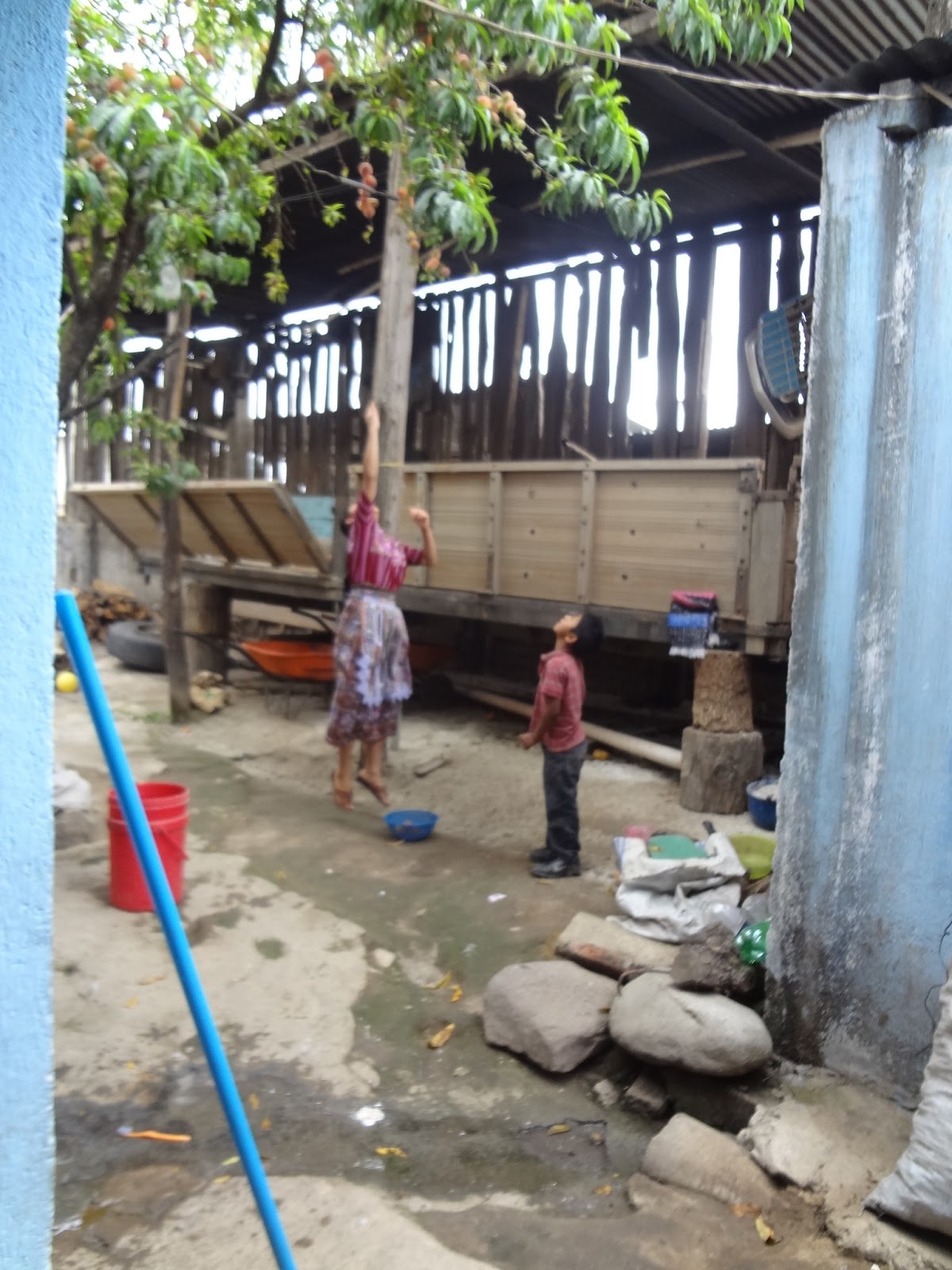
Kind people at a house I visited for an interview gave us fresh peaches from their tree. It was such a lovely gesture that some part of me thought, certainly such a nice peach, given of a kind heart, couldn't make me sick? Unfortunately it was freshly washed. Still can't handle the water.
Johnny is continuing his Spanish classes at a school called Jabel Tinamit. I believe he is on week five, including our time in Antigua. He studies four hours a day, one-on-one with an instructor, plus homework in the evenings. He's made a ton of progress and is practically chapin now. (Chapin = Guatemalteco).

During our first couple weeks, I missed Antigua a bit, as life there was pretty cush. We lived in a beautifully designed, eco-conscious shared house owned by a Japanese couple our age. There were beautiful ruins and cathedrals everywhere you turned, organic restaurants, gourmet food shops, little haunts to enjoy freshly juiced licuados, cafes around flower-filled gardens, peaceful parks to sit by the fountain and even yoga class at the fancy hotel around the corner from my house. I spent a lot of time wandering, reading and unwinding my brain. Oh yes, and weaving. That was my favorite part. 

Panajachel -- or Pana, as it's known -- is touristy but in a different way. The main drag is lined with stalls selling bags, t-shirts, jewelry and pants. Some vendors are more aggressive, walking into restaurants and plopping their goods half-way onto your plate: hand-woven table runners, table cloths, bracelets and quetzal key chains. A couple days ago a lady actually wrapped my head in a head scarf while I was mid-conversation. There are many small stores that seem to all sell the same snacks and gross drinks... not as many unique, adorable little haunts as Antigua. But some.

Now that we have settled in, I am feeling more comfortable and enjoying it more every day. It should not go without saying that Lake Atitlan is absolutely beautiful. It is a huge crater lake surrounded by three volcanoes, and there are all these lovely towns nestled into its shores which you can reach by boat-taxi.
Each town has its own character: one is known for its many coffee and weaving coorperatives; another is the hippie haunt where the gringos have set up pyramid retreats, aura cleansing and reiki massage; one is home to the infamous Maximon.
On the docks in Pana
We have a nice, funky little apartment here. It took a little getting used to after the luxuries of Casa Menta, but now that I've had a mental reset, it is becoming near and dear to my heart. Sometimes there will be enormous spiders, and we all just have to deal with that.
Our place in Pana. You wish you thought of that color scheme.
Ours is one of a complex of six bungalows on a gated property. We have two bedrooms, a bathroom with a nice hot shower (and it doesn't even use an electric showerhead -- this is a luxury!), kitchen dining area and living room. We buy gas for the stove and jugs of agua pura from the land lady who lives on site, Helen. We have to use agua pura for everything from drinking and washing vegetables to brushing our teeth.


Like many houses, our bungalow is made of concrete block. It's topped off with a metal roof that makes even the lightest of rainstorms a real party. It's on a quiet street just off Calle Santander, where a majority of the touristy restaurants, book shops, cafes and Sombrilandia (which sells fresh fruit popsicles) are located. We're just a leisurely stroll from the docks.

That is my Sunday update. Today is market day, so we're off to buy our tomatoes, zucchini, onions, carrots and bananas for the week.

Miss you and love you!

Cara and Johnny

Wednesday, April 24, 2013

Bruno and "Tay keare"

Spending time at Irla's house, learning to weave a traditional tejido on a backstrap loom, was one of my favorite activities while in Antigua. I made daily trips to San Antonio Aguas Calientes where Irla and her family live and basically tied myself to a tree on their patio to work on my weaving and hang out with their family.

They have two dogs, rambunxious but sweet Bruno and old, blind Dalmatian mix "Tay keare".

At first I thought "Tay keare" was perhaps a Kaqchikel word or something in Spanish that I had never heard of. Then I realized what they were actually saying: take care. The dog´s name is Take Care. When they bought him as a pup, the sellers waved good bye and said, "Take care of yourself, perro!" (although this was en español). So they dubbed him Takecare.

Irla´s dad, Luis, was the man behind this great name. He is a charming and playful guy who clearly loves learning new things, although access to new information is limited to chats with neighbors, visitors and a fuzzy connection to the Discovery Channel from his room. I bet he would go crazy over some internet access.
Luis and Bruno
Some years ago, Irla met a Japanese traveler interested in studying traditional Mayan weaving. He became a good friend of the family, and since then, Irla´s has become a staple stop among Japanese tourists in Guatemala. She hosts house guests, teaches traditional weaving and gives cooking demonstrations in her home. She showed me a picture of her published in a Japanese tourism magazine.

As a result of this cultural exchange, her dad Luis, a Guatemalan man who speaks Kaqchikel and Español, can greet you in English and say, "I´m full" in Japanese. What a world.

Many days while I was working on my tejido, the family would invite me stay for a homemade lunch, eaten around 1 o´clock. We would all sit around their wobbly table with a big hole in it and chat while we snacked on hot elote, slurped soup and ate piping hot tortillas no bigger than the palm of my hand with fresh slices of lime. I drank special agua pura and everyone else had Coke or a mysterious orange sugar drink. We said, "Buen provecho" both before and after the meal, and thank you to each person before getting up from the table. If you weren´t careful, Bruno would without a doubt try to steal your seat. He loves sitting in chairs.

Irla, Sherlley and Derek

I loved these lunches because of the stories that were shared, especially by Derek (Irla´s highly imaginative four year old son) and her father Luis. It was sometimes a challenge to understand him because I often wasn´t quite sure which language he was using.

He taught me some of my first words in Kaqchikel, and I taught him new phrases he wanted to learn in English, like, "Thank you, I hope to see you again" and "Dig in, everybody!" He told me that during his two years with the army, he met some gringos who used to call him "baby face."

Derek, an outgoing and highly adorable four year old, told some great stories at lunchtime. He typically drank a cup of coffee for breakfast, so he was rarin´to go by lunchtime.

"Once, when I was little, I climbed all the way up a tree and then I FELL! I fell down out of the tree and I fell into a hostal." (As I wondered if I had understood his story, Irla muffled a laugh and quietly told me that that hadn´t in fact happened). Another day he announced, "Last night, I had the best dream! I had a dream that dad bought me new shoes, and that I had lunch at McDonalds!" 

Bruno sitting in a chair

Inspired by Luis and this great family, Johnny and I have a name picked out for our future dog: Cuidese.


Thursday, April 11, 2013

Market day

With the guidance of our hosts, friendly Antiguenos and a handful of local publications, I'm learning to navigate Antigua. Of course much of this revolves around food: there's Dona Luisa Xicotencatl for the best homemade granola, all-natural peanut butter and warm bread fresh from the oven every day at 2 pm (we first found Dona Luisa's by following the delightful scent of banana bread from about two blocks away); Dona Gavi for vegan ice cream (my favorite flavor so far is coco); Epicure for all manner of gourmet spices, sauces and other Trader Joes provisions (which by the way, I can't even find in Denver); Cafe Condessa for a good cup of joe, the Whiskey Den (needs no explanation) and Sabe Rico for tasty, healthy lentil stews, quiche and fresh fruit smoothies in enormous, colorful glasses. There's even an organic grocery store, Organica, which has all the comforts of Whole Foods at home at about double the price (emergency-only).

But the best discovery so far is the local market, which bustles every Monday, Thursday and Saturday. This is where you go to buy your fruits and veggies for the week from your favorite vendedora. Miwa was nice enough to accompany me on my first trip, and I'm glad she did because it's kind of overwhelming, and certainly much different from a grocery trip at home.

Part of the market is outdoors and part of it winds into an indoor/outdoor labryinth of stalls overflowing with everything from produce and fresh flowers to used clothes and miscellaneous chicken parts. Here you can buy a bar of Dove soap, rice, beans, spices, a dried flower wreath, pirated DVDs, a few days' worth of tomate, aguacate, arroz and uizquil, a new pair of shades or used shoes for just 10Q, candles, meat, dog food and apparently that live turtle you've been wanting. Some sellers have shelves and tables (staked floor to ceiling) while others sit on the ground surrounded by the fruits and vegetables they hauled in.

As you pass these rows of produce altars, women call to you, "Zanahorias! Papas! Mangos a cinco! Que buscas, que buscas?" There are the sounds of music and telenovelas on static-filled screens, polite negotiation, laughter, fresh tortillas rhyhmically slapped together and sizzling.

We wound our way into the heart of the beast, squeezing past men with heavy bags of rice slung over their shoulders and bumping into women in trajes tipicos, colorful skirts and heavy woven shirts of bright colors. I forced myself to concentrate on following Miwa's quick, no-nonsense pace instead of looking around too much for fear of being lost forever.

Finally we arrived at Miwa's favorite vendedora, and began the process of pointing, collecting, counting. Of course there are no signs that say how much anything costs. It's all a business of ask and ask again until you agree.

That day, I bought 2 small eggplant, a bag of tomatoes, onions, broccoli, potatoes, two uizquil (a new veggie), and a bunch of carrots for 25 quetzales, or about $3. Then Miwa whisked me back through the windy halls, past warm marbled meet hanging from heavy hooks, silver fish with staring eyes, towers of brown eggs and children snoozing atop colorful fabrics to her preferred fruit stall where we bought banano (bunches of short bananas), mangoes and a special treat, mangoes para chupar. These are smaller, yellow mangoes that you puncture at one end, squeeze with all your might and suck the juice out of for a sweet, sticky treat.

I'm happy to say that I was able to find these two sellers again when I returned to the mercado with Johnny a couple days later. (Truly, the layout of this place is so confusing that I was quite proud of myself). There's something really fun about gathering your food on the same day as everyone else without shopping carts, price checks or fluorescent lights. Of course we learned our lesson: it is best to go earlier in the day than later, when the chicken I mentioned has been sitting out all afternoon.