Friday, May 17, 2013

Monterrico - Our trip to the playa

Casita de Monterrico
We spent the weekend on the coast with friends from Johnny´s Spanish school. The founders of the school, who had recently celebrated their anniversary, decided to join us for some R&R on the black sands of Monterrico.
Getting our dose of fruit at "Johnny´s Place"
The trip centered around relaxing, getting tossed about by the strong waves (Johnny came home with bruises), trying every licuado (fruit smoothie) on the menu at Johnny´s Place and sweating.

We got up early for a boat ride at the Nature Reserve, a mangrove marsh full of "four-eyes fish" and swopping egrets. At 5:30 in the morning, we paddled through the calm waters for a nice dose of nature, along with the fisherman who work the fresh and salty waters.

Another highlight of the trip: the pineapple truck! You can buy three amazingly tasty pineapples for 10Q (just over $1). The vendor quickly cuts it for you, turning the green top into a handle for chowing down. Pineapple drumstick!

Johnny also made friends with a rather large pelican...

 See all the photos here.

Sunset on the black sandy beach.


Wednesday, May 15, 2013

Getting around the field

On Monday, Johnny and I took the bus to Chimaltenango, not far from Antigua, for a follow up interview with a Friendship Bridge/Kiva client. 

Typically, I get myself to the general area where the clients meet, then meet up with the group´s loan officer who takes us "in." We´ve walked up steep trails, puttered and buzzed in tuc tucs, taken microbuses and vans and piled in the back of pick up trucks (called picops). 

Monday was the first time I hopped on a motorcycle. Don´t tell Dad.

Cruisin´ with Oswaldo in Chimal. Earning my investment in travel insurance.
Part of this client´s daily walk home in Xela
Tuc tuc

How to support the women of Guate

Trust Bank members in Chimaltenango
Friends and family have asked how to support the women and Trust Bank groups I´ve been lucky enough to meet. There are a couple ways:
  1. Make a donation to Friendship Bridge. Based in Denver, they provide an impactful combination of microcredit and education to Guatemalan women. I´ve been pleased to find that they have an excellent reputation in the field and here in Guatemala.
  2. Become a lender on Kiva.org. Kiva connects people through lending to alleviate poverty. They leverage the internet to let individuals like yourself lend as little as $25 to help create opportunity around the world. A worldwide network of partner institutions, called Field Partners, are responsible for screening borrowers, disbursing loans, collecting repayments and otherwise administering Kiva loans. Friendship Bridge is a Kiva Field Partner. 
On a field visit in Patzun with loan officer Francisca. 
I am growing out my bangs. Sigh.

You can lend directly to a Friendship Bridge client through the Kiva site by searching for "Friendship Bridge" in the Choose a Borrower search, or you can search by country (Guatemala) and look for the Friendship Bridge logo in the loan description.

For example, the "Uvas Group" (The grapes! What a name...) is a Friendship Bridge client currently listed on Kiva.org that needs funding. 
(Click here to see their profile and lend).  Good news... looks like this loan has been funded!


Kiva lending is unique and fun (even addictive) because you learn about the individual who receives your loan contribution. You have a sense of connection to that person. And remember, this is a loan, not a donation. Bit by bit, your money is repaid.

During the loan cycle, you will receive an update on how the client´s business is doing and the impact the loan has had on her life. This follow up is written by a person such as myself, who attends a loan repayment/educational meeting and interviews the client directly.
Cara interviewing a Trust Bank president in Xela.
The clients I have interviewed so far have already received their loan disbursement for this cycle, and are typically one or two payments from completing their loan payments. The write ups I composed after the interviews are posted to their client profiile and emailed to the lenders who funded that loan (as far as I can tell, you cannot read them on the Kiva site). 

However, many of the clients  I met plan to participate in another loan cycle once theirs concludes, which means they will likely reappear on the Kiva website.

In the coming months, keep an eye out for these Trust Bank groups in Guatemala:
  • Mujeres Activas
  • Mujeres Chimaltecas
  • Las Princesas
  • Las Orquideas
  • Las Claveles Rojas

And of course, there are many many worthy groups and individuals around the world to be found on Kiva.org, so feel free to lend to whoever inspires you. 

My experience working with Friendship Bridge and Kiva has only solidified my faith in the effectiveness of microcredit lending as a tool to alleviate poverty. I´m a believer!

P.S. If you decide to lend, I would love it if you´d leave a comment below.


    Tuesday, May 14, 2013

    Generals, genocide and documentary footage

    Last Friday, former dictator General Efrain Rios Montt was sentenced to 80 years for genocide and crimes against humanity. This is an historic verdict: the first time a former head of state was convicted in his own country for such crimes. It also has potential implications for the current president:
    "There is serious evidence that the current president, the former military commander Otto Pérez Molina, who took office in January 2012, may have been involved in the same mass killings for which General Ríos Montt has now been convicted." - NY Times
    There are many layers to this tale, from the CIA's involvement in the coup that overthrew the president in 1954 to documentary footage shot in the early '80´s by an American filmmaker which was later used as evidence in the trial.

    Before we came to Guatemala, many people recommended the film When the Mountains Tremble as a valuable introduction to the years of civil war that scarred this country. (We got it on Netflix and watched, and got nervous about our trip...).

    The "sequel," a documentary called Granito, tells the story of  how out takes from the 1983 documentary provided key evidence for bringing the indictment. The filmmaker literally went digging through old footage from decades before and uncovered key interviews and other evidence that built the case for genocide.

    It is available to view in its entirety until May 25 on PBS.org. It is fascinating how footage from decades before has come back to haunt the present day. Anyone interested in film production will especially appreciate this. I hope you will all make time to watch.

    Watch Granito: How to Nail a Dictator - Trailer on PBS.


    Watch Granito: How to Nail a Dictator in full until May 25 on PBS.


    Dig further into the drama with this read: 

    Bitter Fruit: The Story of the American Coup in Guatemala. 

    '"Bitter Fruit" is a comprehensive and insightful account of the CIA operation to overthrow the democratically elected government of Jacobo Arbenz of Guatemala in 1954. First published in 1982, this book has become a classic, a textbook case of the relationship between the United States and the Third World. The authors make extensive use of U.S. government documents and interviews with former CIA and other officials. It is a warning of what happens when the United States abuses its power." - Goodreads.com

    Friday, May 10, 2013

    Microfinance and a free Kiva trial

    Since we came to Panajachel, I have been working with an international non-profit NGO called Friendship Bridge (Puente de Amistad), which provides microcredit and education to Guatemalan women so that they can create their own solutions to poverty for themselves, their families, and their communities. They have several offices throughout Guatemala and are headquartered in Lakewood, Colorado.

    Friendship Bridge has a partnership with Kiva, a non-profit organization with a mission to connect people through lending to alleviate poverty. Kiva leverages the internet (crowd sourcing) and a worldwide network of microfinance institutions, to let individuals like yourself lend as little as $25 to help create opportunity around the world (pick Guatemala!).

    This video from Kiva does a good job of explaining it in a nutshell.


    A few years ago, my boss Sue gave me and my co-workers each a Kiva gift certificate for the holidays, and since then I have been hooked on Kiva lending (thanks, Sue!).

    If you´ve never tried it, I highly recommend you give it a go. An anonymous donor is currently offering a free trial to new donors so you can try Kiva for free. You get $25 to make a loan free of charge. Your $25 will be disbursed to a business owner, who will repay it to the sponsor. If you want to put up your own dinero, the repayment comes back to you.

    I´m so grateful to have the opportunity to support these two very fine, very effective organizations. I am responsibe for visiting Friendship Bridge/Kiva clients at their repayment meetings where I conduct follow-up interviews (in Spanish or with a translator who speaks their Mayan language), and drafting the stories that are then posted to the Kiva website and sent to those who helped to fund the loan (That could be you! Just sayin'...).

    Interviewing clients in Chichicastenango. My shirt makes me look like a missionary.
    This charge has taken me to more off-the-beaten path areas that I otherwise would not get to see, and of course, brings me face-to-face with amazing women who have made tremendous strides in improving their lives. So far I have met with six groups in Quetzaltenango, Patzun and Patzicia (Chimaltenango) and Canton Patzibal (Chichicastenango), and the experience has made a believer out of me: microcredit combined with education makes a real difference.

    Tuesday, May 7, 2013

    First crack at Kaqchikel


    Most students who study Spanish here in Guate average four hours a day of one-on-one instruction. Kaqchikel lessons, though, max out at two-hour increments. Yesterday, I discovered why.

    Kaqchikel is one of some 22 or 23 distinct Mayan languages spoken by indigenous people here in Guatemala. It sounds like some combination of Spanish, Hebrew, French, popping, clicking, swallowing, clearing your throat and speaking with a candy in your mouth. (To clarify, this is indeed a pleasant sound). It's common to the areas in which we are travelling, and I thought it would be nice to know some basic greetings when visiting Friendship Bridge clients or chatting with the people around me. Many people in the cities speak Spanish plus an indigenous language.

    I love learning new languages (or "collecting" them, as a friend once said) and usually pick things up pretty quick. I thought that I had a pretty good ear for subtleties in languages, perhaps even a head start thanks to my many Jewish friends who have taught me to "hhhuch" -- until yesterday, when I spent about 10 minutes trying to correctly pronounce "good afternoon."

    I just couldn’t get it out and couldn't hear what I was doing wrong. We went back and forth:

    Gregorio: Good afternoon
    Cara: Good afternoon.
    Gregorio: No. Good afternooooon.
    Cara: Good afternoooooon.
    Gregorio: Good. Af-ter-noooooon.
    Cara: Good. Af-ter-nooooon.
    Gregorio: No.
    Cara: Good afternoon.
    Gregorio: Si!
    Cara: Good afternoon.
    Gregorio: No...

    In my defense, though, I wasn't just talking jibberish: with the slight adjustments I was apparently making, my teacher Gregorio told me my pronunciation of, "I'm going to hit the table" was perfect.

    He also got a big kick out of my attempt at "good morning," or as I like to say, "You have big horns."

    After the first hour, we had to take a break. We both needed a glass of water for our sore throats. I did have some success, however, and it is fun to practice. People are really tickled when you try to speak Kaqchikel (probably because I am talking all kinds of nonsense).

    My new nickname is "Palaj" which means "face" (just like "cara" does in Spanish).

    Here's a video I found on the world wide web for you to hear how it's really done.


    I will keep you all posted on my progress.

    Sunday, May 5, 2013

    Update from Panajachel


    Johnny in front of our apartment in Pana
    Saludos friends and family!

    It's been awhile since I last wrote -- a surprise to us both. I was expecting to spend long mornings blogging away, but the truth is I'm suffering technology frustrations. I brought an iPad and keyboard, which as it turns out is not the same as working on a laptop, especially for loading pictures, formatting blog posts, etc. I also decided to load all our pictures onto Google+ thinking that would make it easier to insert them into blog posts, but that turned out to not be the case. Ugh.

    When you have some time to peruse photos, hop on to Google+ and you can see all the pics! (If you can't see them, let me know and I will add you to my circle of friends. Still figuring out Google+...).

    I would love to answer your questions and hear from you!

    We've set up camp here Panajachel, a town on Lake Atitlan. This is where one of the Friendship Bridge/Puente de Amistad offices is located. I am working part-time with Friendship Bridge to collect follow-up stories on clients who have received micro credit loans through their partnership with Kiva.

    So far I've met three clients, including one Trust Bank group. Meeting these women is the part that I like best about being here. I visit places I would otherwise not go -- the high hills of Quetzaltenango, the outskirts of Patzun and Patzicia. I am invited into homes, smiled at by cute kiddos and gifted homegrown apricots that later give me tremendous diarrhea.
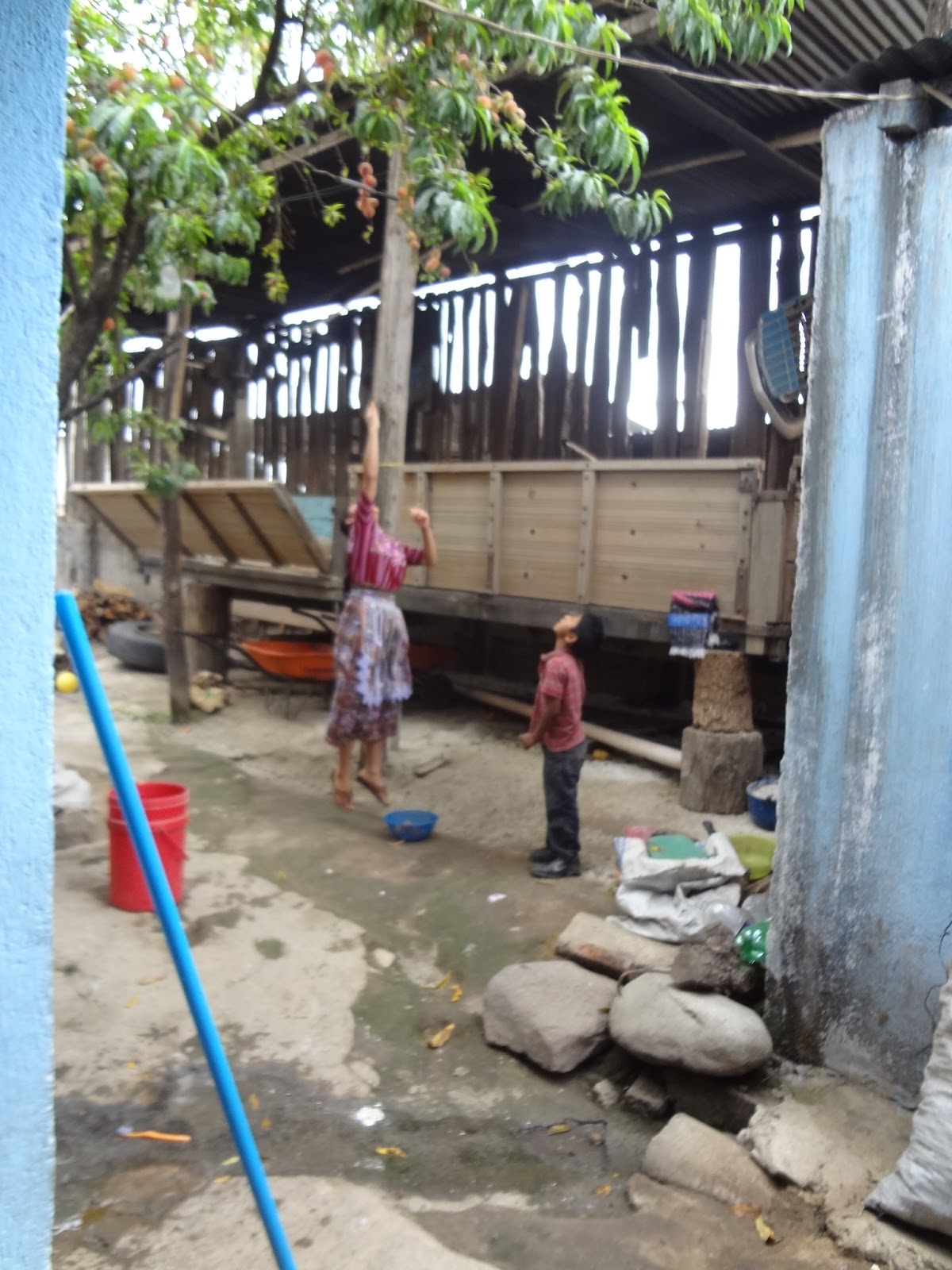
    Kind people at a house I visited for an interview gave us fresh peaches from their tree. It was such a lovely gesture that some part of me thought, certainly such a nice peach, given of a kind heart, couldn't make me sick? Unfortunately it was freshly washed. Still can't handle the water.
    Johnny is continuing his Spanish classes at a school called Jabel Tinamit. I believe he is on week five, including our time in Antigua. He studies four hours a day, one-on-one with an instructor, plus homework in the evenings. He's made a ton of progress and is practically chapin now. (Chapin = Guatemalteco).

    During our first couple weeks, I missed Antigua a bit, as life there was pretty cush. We lived in a beautifully designed, eco-conscious shared house owned by a Japanese couple our age. There were beautiful ruins and cathedrals everywhere you turned, organic restaurants, gourmet food shops, little haunts to enjoy freshly juiced licuados, cafes around flower-filled gardens, peaceful parks to sit by the fountain and even yoga class at the fancy hotel around the corner from my house. I spent a lot of time wandering, reading and unwinding my brain. Oh yes, and weaving. That was my favorite part. 

    Panajachel -- or Pana, as it's known -- is touristy but in a different way. The main drag is lined with stalls selling bags, t-shirts, jewelry and pants. Some vendors are more aggressive, walking into restaurants and plopping their goods half-way onto your plate: hand-woven table runners, table cloths, bracelets and quetzal key chains. A couple days ago a lady actually wrapped my head in a head scarf while I was mid-conversation. There are many small stores that seem to all sell the same snacks and gross drinks... not as many unique, adorable little haunts as Antigua. But some.

    Now that we have settled in, I am feeling more comfortable and enjoying it more every day. It should not go without saying that Lake Atitlan is absolutely beautiful. It is a huge crater lake surrounded by three volcanoes, and there are all these lovely towns nestled into its shores which you can reach by boat-taxi.
    Each town has its own character: one is known for its many coffee and weaving coorperatives; another is the hippie haunt where the gringos have set up pyramid retreats, aura cleansing and reiki massage; one is home to the infamous Maximon.
    On the docks in Pana
    We have a nice, funky little apartment here. It took a little getting used to after the luxuries of Casa Menta, but now that I've had a mental reset, it is becoming near and dear to my heart. Sometimes there will be enormous spiders, and we all just have to deal with that.
    Our place in Pana. You wish you thought of that color scheme.
    Ours is one of a complex of six bungalows on a gated property. We have two bedrooms, a bathroom with a nice hot shower (and it doesn't even use an electric showerhead -- this is a luxury!), kitchen dining area and living room. We buy gas for the stove and jugs of agua pura from the land lady who lives on site, Helen. We have to use agua pura for everything from drinking and washing vegetables to brushing our teeth.


    Like many houses, our bungalow is made of concrete block. It's topped off with a metal roof that makes even the lightest of rainstorms a real party. It's on a quiet street just off Calle Santander, where a majority of the touristy restaurants, book shops, cafes and Sombrilandia (which sells fresh fruit popsicles) are located. We're just a leisurely stroll from the docks.

    That is my Sunday update. Today is market day, so we're off to buy our tomatoes, zucchini, onions, carrots and bananas for the week.

    Miss you and love you!

    Cara and Johnny